The 2026 Women’s History Month theme, “Leading the Change: Women Shaping a Sustainable Future,” provides a timely framework for examining women’s leadership within the global fashion industry. Fashion, one of the world’s most resource‑intensive sectors, has become a key site for sustainable innovation. Increasingly, women designers, educators, and entrepreneurs are driving transformative practices that integrate environmental stewardship, economic equity, and cultural preservation into fashion’s future.
South Asia Women Leading the Charge for a Sustainable Fashion Future
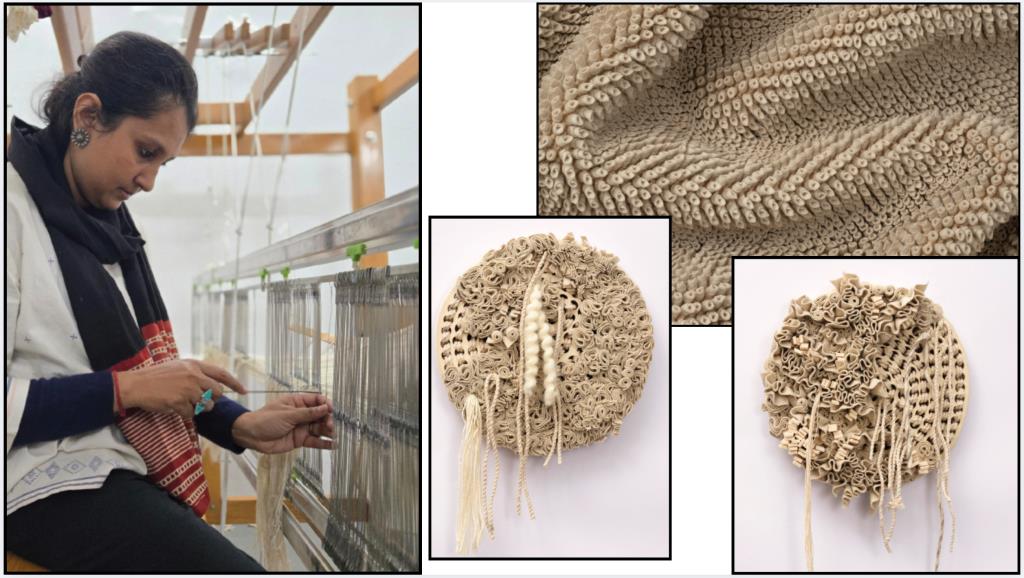
Artist Darshani Patel of Thread Revival Collective, weaves together jute, wool, and other organic fibers, on a large loom. She then shapes these woven pieces into organic creations that evoke natural forms and unique textures. (Image credit: heartfullness.org)
In South Asia, Ananya Patel of India’s Thread Revival Collective integrates environmental and economic sustainability by training rural women, like Darshini Patel, to transform discarded textiles into marketable goods. Her enterprise bridges the informal economy with global fashion markets, demonstrating how circular production systems can align with poverty alleviation and women’s empowerment. Patel’s organization provides living wages and skills development, contributing to both gender equity and resource conservation.
Collectively, these examples highlight a growing paradigm in which women redefine leadership through relational, community‑centered models rather than hierarchical structures. Their work embodies ecofeminist principles that link the care of people and planet, challenging patriarchal and extractive systems long embedded in industrial fashion.
Immigrant Women in the United States Drive Sustainability

Maria Torres, creator of the fast-growing immigrant-owned sustainable fashion boutique — Marian Style. (Image credit: Latinfashionweek.com)
Maria Torres, a Salvadorian‑American designer based in Los Angeles, approaches sustainability through material innovation and collaborative supply chains. Her collections utilize plant‑based alternatives such as cactus leather and organic cotton sourced from women’s cooperatives in Oaxaca. This model exemplifies sustainable economics, redistributing value along the supply chain while reducing dependence on petroleum-based synthetics. Torres’s work also foregrounds the intersectionality of sustainability, recognizing that environmental accountability cannot be separated from social justice and labor equity.
American & European Matriarch’s of Fashion’s Sustainable Movement

Early adopters of the sustainable movement in fashion: Eileen Fisher, Mara Hoffman and Stella McCartney. (Image credit: Vogue.com)
In the U.S., sustainable design has evolved from a niche pursuit to a powerful movement shaped largely by women innovators. Designers such as Eileen Fisher pioneered circular fashion systems, extending the life of garments through repair and resale programs. Her model inspired many of us to question not only how our products are made but what happens to them after purchase. Similarly, Mara Hoffman’s commitment to transparency and regenerative fibers has shown that sustainability can coexist with commercial viability and aesthetic excellence. For emerging American designers, these examples offered both blueprint and challenge: to design garments that meet ethical, environmental, and emotional needs simultaneously.
University of Fashion’s Female Contributors to Fashion Sustainability
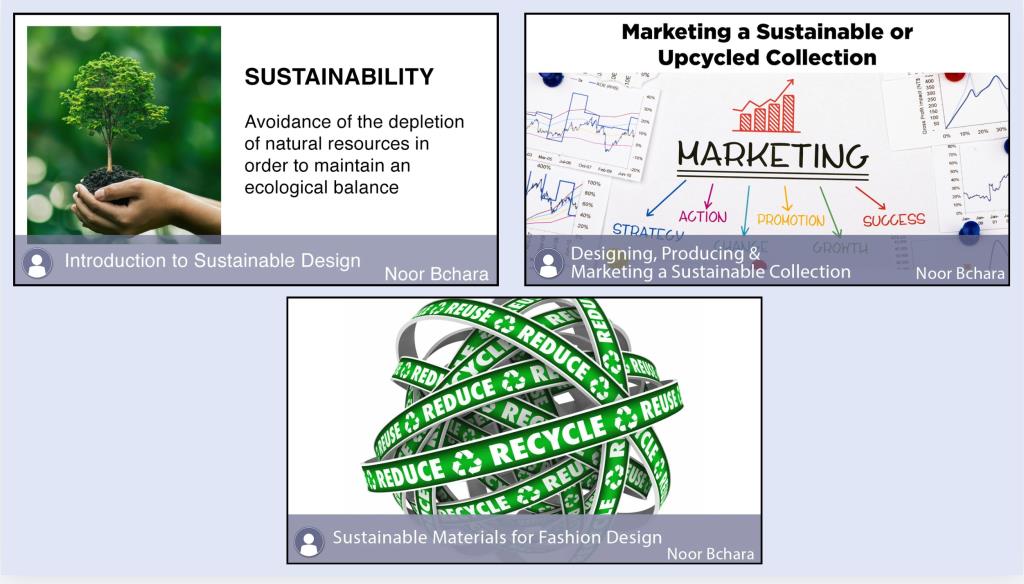
UoF’s Sustainable Design Series taught by Noor Bchara (Image credit: University of Fashion)
The University of Fashion has long demonstrated leadership in advancing the discipline’s commitment to sustainability through its comprehensive collection of instructional lessons led by distinguished fashion educators. Among these experts is Noor Bchara, founder of the Upcycle Design School and a recognized authority in sustainable fashion practices. Bchara has developed three foundational courses for the University of Fashion: Introduction to Sustainable Design, Sustainable Materials for Fashion Design, and Designing, Producing, and Marketing a Sustainable Collection—each designed to equip emerging designers with the knowledge and methodologies essential for responsible creative practice.
In addition to her pedagogical contributions, Bchara is an Alumna of the Arts Envoy Program, through which she collaborates with the U.S. Department of State to promote upcycling and circular design principles internationally. Her expertise is widely recognized, as evidenced by her frequent lectures at major art and fashion institutions and her participation in prominent global industry events.
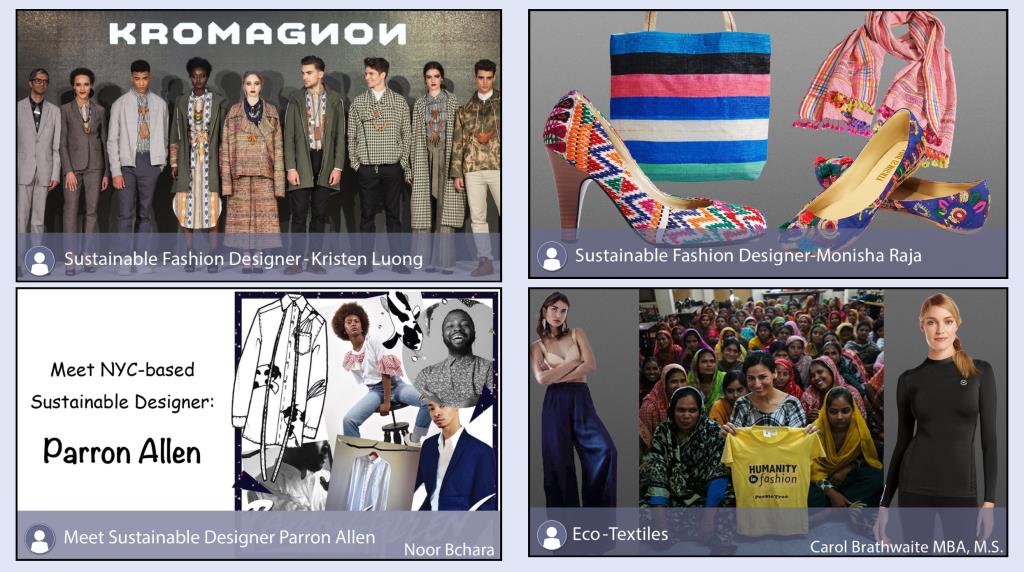
Kromagnon was born in 2012 when Kristen Loung toured several textile factories in France and Italy with fellow FIT students. She began researching sustainable fabrics and practices through a scientific lens informed by her Pre-Med background at NYU. Applying an analytical approach, she examined the environmental trade-offs of various materials, discovering that even sustainably sourced fabrics often require extensive chemical processing. Her investigation culminated in a deep understanding of sustainable textile production, enabling her to source ethically aligned suppliers and manufacturers, insights that laid the foundation for Kromagnon, a brand dedicated to responsible and innovative fashion design.
Love is Mighty was a New York based luxury footwear and accessories brand committed to sustainability, Artisanal Craftsmanship and Cruelty-Free fashion. Monisha Raja, Founder and Creative Director, is a graduate of Parsons School of Design and the recipient of the P.E.T.A. Fashion Award for her dedication to Animals and Fashion. The company was dedicated to creating products that showcased an exceptional combination of modern design, innovation and ancient mastery, through collaborations with semi-nomadic tribes of the world.
Parron Allen, while not a female designer, he is worth mentioning here. Parron’s design practice embodies a harmonious dialogue between whimsy and functionality, articulating a distinctly contemporary aesthetic voice. Through his work, he reclaims the practice of upcycling as a cultural and ancestral homage to his Mississippi roots, transforming fabric remnants, discarded textiles, and thrifted garments into inventive, narrative-driven collections. Before establishing his eponymous brand in 2021, Parron Allen pursued formal design studies in both the United States and the United Kingdom and refined his technical and creative expertise at notable fashion houses including Vera Wang, Ellen Tracy, and Rebecca Taylor.
Eco Textiles is taught by Carol Brathwaite who served as an Adjunct Instructor at New York City College of Technology (City Tech), where she taught courses in textiles and fashion marketing. Drawing on over ten years of experience as a Senior Technician in Con Edison’s Chemical and Environmental Laboratory in New York, her lesson examines key innovations and contemporary developments in sustainable textile production and associated best practices and addresses ongoing efforts to reduce the environmental impact of textile manufacture, use and disposal, and considers the prospective trajectory of the global fashion industry as it continues to evolve toward greater ecological responsibility and awareness.
From South Asia to the United States and Europe, women are redefining what it means to lead in fashion by merging creativity with conscience. Their work advances a model of sustainability that values people as much as the planet, one rooted in equity, education, and cultural continuity. Whether training rural artisans, developing next‑generation materials, or teaching the next wave of designers, these leaders are weaving a new narrative of fashion that is circular, ethical, and inclusive. Collectively, they embody the ethos of Women’s History Month 2026: not simply participating in change, but leading it, stitch by stitch, community by community.
-------------------------------------
By: Francesca Sterlacci
Title: Leading the Change: Women Shaping a Sustainable Fashion Future
Sourced From: www.universityoffashion.com/blog/leading-the-change-women-shaping-a-sustainable-fashion-future/
Published Date: Sat, 14 Mar 2026 18:40:36 +0000
Read More
 FestivalsMusicNew ReleasesArtistsFashion & ClothingVideosPrivacy PolicyTerms And Conditions